Tuesday, 30 July 2013

The Last Of Us Review

Story has made a comeback in recent years. With games like Bioshock starting the trend this generation, more developers have tried to compete with movies and try to make a game with a few more brain-cells in their head than Transformers. A few games have succeeded (Spec Ops: The Line), and even more games have failed (Max Payne 3, The Witcher 2 and Heavy Rain). I'm not saying the aforementioned games aren't good, just that they don't live up to their ambitions. Max Payne 3 was hella fun to play, but it took itself to seriously and tried to hard to be a Mystic River type deal, despite being contrasted with jumpy-fun-shooty gameplay. So where does The Last Of Us stand? Sadly, in between.
The transformation of a character.

The problem with trying to have a good story in a shooter is that the story is supposed to inform gameplay, and the story of the typical modern-day shooter is 'Shoot a load of guys in a grey/brown industrial area and get a bad ending'. The thing about killing another human is that it's supposed to affect you in some way. You either go traumatized and deluded like Captain Walker, or power-crazy like Jason Brody. Other games like Bioshock and Half-Life handle this differently, like choosing your own level of immersion in Half-Life, where you as a player can morally decide yourself whether they're affected or crazy, or in Bioshock where you're just a clockwork orange and you have no emotion or choice.

Most shooters, The Last Of Us included, have a main character that can kill all in his path without feeling anything, without being affected at all. You would have thought that in a post-apocalyptic world where human life is few and far between, human life would have some value, but it doesn't, they can just kill whomever they please. Death is part and parcel in their daily life, and maybe that's why they're not affected, because they have become completely desensitized to it. Be that as it may, it doesn't make an interesting story at all. There's no character arc there. If they start out as a disheveled, traumatized killer and end as a disheveled, traumatized killer then bugger all has happened and the story is boring and pointless. Ellie is a really cool character, full with personality and charm, and in a world where everyone is bland and underdeveloped, Ellie seems like fruit in a laundry basket.

The back story is, you know the drill, a zombie apocalypse has wiped out 95% of humanity and the world is left in ruins and the remaining humans have to live under strict supervision in order to survive. But with Ellie, they find hope in a cure, or at least I think so, it becomes kind of hard to follow after a while and it certainly lacks decent direction. Most times, I don't know why I'm going there or why I should care. At first there's a capital building which turns out bogus, then Bob's place, then a bridge, and in the midst of play, caring about where your going isn't important. It's a case of shoot first and ask questions later. The story is actually really well told, with few cutscene's, it rely's on Half-Life's method of storytelling which is to use the world to tell a story. You don't need characters blabbling at your face for half an hour, telling you that the worlds gone all apocalypse-style like we're playing a JRPG. The run-down buildings, the make-shift houses, the way characters respond to your presence, it all adds up to a hugely satisfying world, a world that has been crushed and defeated, where people hold on to whatever shred of hope they have in sheer desperation. It's incredibly effective and well-done. While well-presented, it comes across as too safe and rather predictable, with no huge game-changing twists or moral dilemma's to make things more interesting.


The gameplay? Yeah, it's alright. It's kinda like Uncharted with it's optional but still broken stealth, cover-based shooting, and puzzle things. It even has that thing where if you don't activate the next set-piece, a clue will come up and just tell you what you need to do. The shooting is kinda clunky but you get used to it after a while. I don't like how you have limited ammo with limited clips but the zombies keep charging at you and whacking you. They often come in groups too, making gameplay all the more stressful, trying to handle health packs and reloading and Ellie all at once. I like the lack of objective markers but it often makes it difficult for you to know where you are. In a world where the whole world has been run down, all the environments are alike. You move from run-down town #1, to run-down building, to run-down town #2. If you're in a building and there's a place to be, you'll find yourself running in circles, seeing the same room 50 times, and since all rooms look the same, you'll technically be seeing the same room 2,500 times. However, I do appreciate how Naughty Dog managed to make fun gameplay which also stuck to the tenants of Survival Horror. Gameplay is panicky, resources are few, melee weapons degrade over time (and at least there's a hit meter so you know when your baseball bat's gonna call quits), it's claustrophobic, it encourages stealth so you're not forced to waste resources, and most importantly it's avoidable, especially when cauliflower monster is raging up behind you, all you want to do is swipe that keycard and get out of there before he turns you into cauliflower monster #2.


You can easily stealth past guards to the next room so you don't have to waste time and ammo, but the stealth is often frustrating due to spotty AI and the fact that often times, the ratio of Enemies to Cover is 3:1. You get behind cover to hide from Guard A dead ahead, but Guard B comes to your right, so you try to find further cover to hide from both guards, but Guard C comes to your left and no way will you be able to hide from all 3 of them unless you're hiding in a bloody box.

My main problem with the game is that there's no weight to any of the death and gore. Sure, we get it, everyone's become desensitized to death and blood and zombies because it's been part and parcel in daily life for 20 years and all that bollocks, but there's no transformation, it just skips straight ahead. Literally, it just skips that 20 years of character development and world degradation which would have made a far more interesting game, but instead we're stuck with a game that lacks gravity in it's death. In a survival game, the life of another human should mean something, and it does with Ellie, but Joel doesn't care at all. In Telltale's Walking Dead, the player is utterly shocked when a human takes another human life, and even if that human is unpleasant to us, we still risk our lives to save that human because he's a human being. The Walking Dead handled life and death far better than The Last Of Us did.

Also, the title makes no sense. The last of who exactly? There are loads of humans, enough to make districts and an armed force. If we are the last of the human race, which is what the title implies, surely human life would have value. If we are the last of our kind, why is Joel and Co. oh so happy to rid the world of humans like Skittles? Sure, there's an uprising group called Firefly, but what exactly are they uprising against? The US Military are only trying to stop people getting infected, and Firefly are just whining and pissing their pants, and for what? For the most part, we're killing survivors who we could easily befriend. The survivors even tell us this, that we gave them no choice. It's like a dead serious Spec Ops: The Line without any moral dilemma.

But of course, there's a further complaint: how are we supposed to relate to a character who kills all the time and shows no signs of being affected? More importantly, how can we sympathize with someone who tortures people? Joel, for the most part, is an unpleasant guy. He is completely neglectful to what Ellie wants, and when Ellie dares to try to lighten the mood, all Joel cares about is getting to the next ledge and killing the next cauliflower monster. Then all of a sudden when Ellie goes missing, Joel tortures people for information. What pisses me off is that there's no transformation for Joel, he just suddenly becomes attatched to her apropos of nothing. What pisses me off even further is that he stabs a guys knee off, snaps the dudes neck even when the poor dude gave Joel the information, then proceeds to bludgen a defenseless, subdued 'enemy' to death. And he gets away with it. There's no punishment, not even a moral conflict for Joel, he just carries on.

We can sympathize with the fact that his daughter was killed because of the outbreak, but that's it. That's seriously the only reason why we can sympathise with this tea-tray shallow vessel of a character. At the end, he pretty much kills everyone, yet he shows no remorse, there's no payback for Joel, no moral payback or anything. It's like Michael Haneke's Funny Games except we're supposed to be rooting for the bad guys.

We can see that Joel taking Ellie under her wing as a father figure shows that he's still desperate for a daughter in his life, that he still hasn't got over her death and is channeling his need through Ellie, which does make sense in the end. Thinking about it, why is Ellie even here? She's running round the battlefield, obviously in the enemies sight, but doesn't get spotted. She's neither a hindrance or a help. Sure, she's there for the story, but this is where the dots don't connect: the story and gameplay are almost completely disconnected.
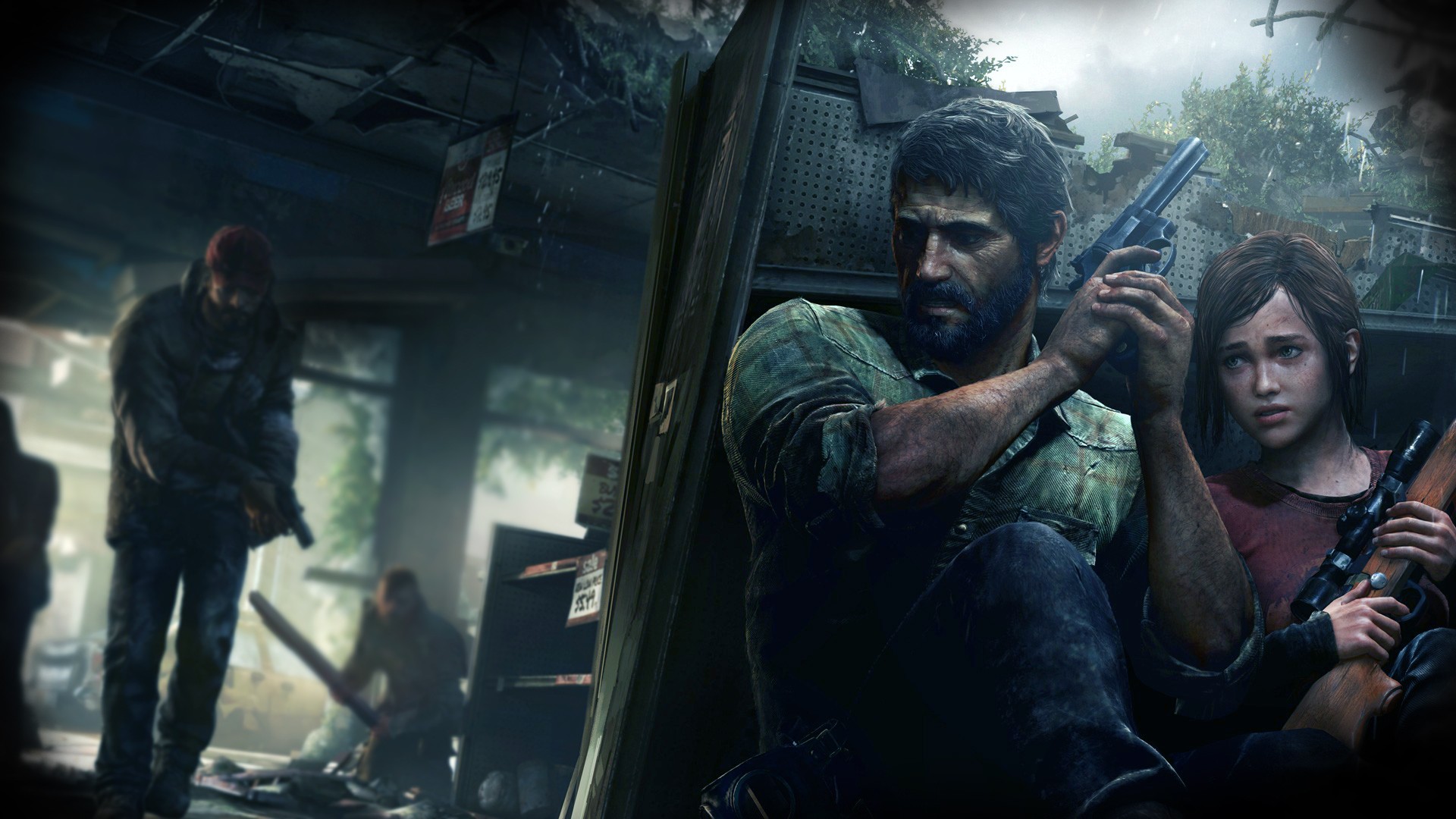

The game is a pretty huge mixed bag, showing pure excellence in some areas and laziness and haphazardness in others. I think Naughty Dog, although great, aren't suited for the job of a game like The Last Of Us, mainly because they aren't all that great with characters and Uncharted was notable for having a 'shoot first, ask questions later' theme to it, which has been continued into The Last Of Us. Maybe this isn't the correct genre for a game like this, perhaps Point-and-Click Adventure would have been perfect. Although a man escorting a young girl through a zombie apocalypse to a safe haven is already a game, a much better game, and maybe that's why The Last Of Us fails: because it tries to be so many things at once. It's immersive, beautiful and fun, but it all fails to come together with all the character development and struggles and the theme of survival.

As a survival game, there's no tension to it. There's no over-hanging long term threat like Far Cry 3's Vaas or Half-Life 2's Dr. Breen. There's no chance of losing everything like XCOM. Most importantly, there's no value to human life like The Walking Dead. What The Last Of Us does well is the gameplay, which is possibly the best example of a survival horror shooter I've seen, far superior to Dead Space. All the realism is in it's gameplay and environments, sadly, there's no realism in it's themes, and in my opinion, that brings the whole game down.

It saddens me, more than anyone, that The Last Of Us didn't succeed for me, and I was bloody pumped for this, because Naughty Dog are excellent. It tried to do so many things at once. It tried to be a fun, bloody zombie-em-up, and also a spellbinding emotional roller-coaster of an epic. In great, story-driven games, the gameplay and story sit in the same room with cups of tea and have a nice chat. In The Last Of Us, the story and gameplay are in separate rooms with merely a peep hole between them, occasionally exchanging eye-contact, if only either one of them had the courage to communicate.

Where The Last Of Us fails the most is that there is no connection between the gameplay and story, thus, this becomes an entertaining, though annoyingly flawed experience. It tries way too hard to impress us with beautiful sprawling environments with a spell-binding Oscar-worthy story, contrasted with limbs blowing apart and heads blowing off, but it doesn't connect the dots. There's Joel with his nailbombs, blowing up survivors left, right and centre, then we're supposed to sympathize with him and his motives. There's no reason why this couldn't have been a movie or a book or a zoetrope, rather than a game. Both the gameplay and the story are good, but the fact that they don't connect brings down the whole experience for me.

If I'm going to leave you with anything, let it be this: "Spinning a plate on a stick is impressive, but try to spin three at once, and you'll just end up digging porcelain out of your face." -Yahtzee Croshaw

Final Verdict: 6.7/10


Wednesday, 22 May 2013

Taxing 'Violent Video Games'

Joe Biden's uneducated face
Vice President Joe Biden has proposed the motion of taxing 'violent video games'. I have put 'violent video games' in speech marks because when Biden says 'violent video games', he doesn't realize that the violence exhibited in video games isn't just non-existent, but it's also almost comical in its approach.

Biden says there's 'no restriction on the ability to do that; there's no legal reason why they couldn't' tax violent video games. Does that mean that you should? Just because you have the legal ability to, does that give you the right to lay a tax on video games that are 'violent'? Despite this, there is a legal problem when taxing violent video games due to the way they express violence: The First Amendment. Video Games are protected free speech under The First Amendment, as ruled by the supreme court.

He said that the tax should go towards victims on gun violence, and this is where he really steps out of line. I would say it's outright offensive to liken the gun crime exhibited at Sandy Hook an Aurora to violent video games. Saying that these deplorable, unlikely crimes are the blame of anything other than the perpetrator and/or the mental illness that the perp has, is irresponsible, offensive to the medium, and just wrong despite of all else. How could one know beforehand that their media will exhibit gun crime? As well as that, one does not simply pick up a video game and want to kill people. Also, why gun crime specifically? Is Biden saying that all games are about guns and blood and guns shooting blood? If a brawler game is taxed for its violence, but the taxes go to gun crime victims, what sense does that make?

Where does Biden draw the line between violent and non-violent. Ok, say all 15 and 18 rated games are taxed. There are some 15 rated games that are completely non-violent, like Skate 3 which is rated 16 because of it's bone-breaking Hall of Meat; will that be taxed for gun violence too? Or Spec Ops: The Line, which is anti-violence in it's purest form, which says that killing for entertainment is deplorable too; will that be taxed for influencing gun violence?

Ok, so let's say he taxes games which exhibit any kind of violence. That means he has to start taxing Mario now, as punching bricks and jumping on heads is a form of violence, and we can have a generation of brick-punching head-jumpers. So if that falls flat on it's face, let's just say he taxes games with guns in them. That means he has to tax Portal, even though those guns don't directly kill anything, and even if the game is rated 12, it will still be taxed for influencing gun crime. Oh, and Scribblenauts too, as you can use a gun in that game, it must be responsible for the Sandy Hook shootings.

All three possibilities land flat on their face, but I think the biggest mistake here is leaving Video Game monetization in the hands of a non-gamer. But this isn't just games, this is all media, and I mean all of it. Murder mystery novels, Anti-war films, Police Dramas, they all be taxed, and for what? For inciting gun violence? It doesn't work like that.

City 17
We wish there was a way to stop shootings like this, but these things aren't exactly common. People go to the movies all the time, and the one time there's a shooting out of the millions of times there's a movie showing, it's still a freak occurrence. We can't prepare for these freak occurrences, because they're bloody freak occurrences. They don't happen often at all, so we can't set up policemen and a SWAT team every time someone goes to school or watches a movie or runs a marathon. It would probably make me feel less safe knowing that there are security cameras and guards watching every move, before this becomes a City 17 society, where we're all controlled by Nurse Ratched so that no one will ever commit a crime ever.

Video Games are expensive as it is, and we don't need a bloody tax on top of it; taxing for something so arbitrary and silly.

Friday, 5 April 2013

BioShock Infinite Review

Doesn't it suck that there are hardly any games that explore deeper themes? Doesn't it suck that there are hardly any games that are truly meaningful? There were only 3 games last year (The Walking Dead, Journey, Spec Ops: The Line) that really meant something, when at the movies in 2012, I can pick 20 films off the top of my head that explored deeper themes that don't focus solely on fun. Sure, I still want dumb fun games, and not all games do have to mean something, but isn't it so much better when they do? Isn't a party so much better when it's celebrating something? Not only is BioShock Infinite the most meaningful and surprising game I've played since Spec Ops: The Line, and the most fun I've had in a linear shooter since Max Payne 3.

Warning: Spoiler Alert
I wont directly spoil anything for you, but there might be some details in this review which you can join the dots and figure out the ending, and it's best to go into it knowing little about it anyway. If you want to avoid having any indirect spoilers, don't read this review until you've played it all the way through. If you want a mini-review: Do not miss BioShock Infinite. It is absolutely incredible, and it's the first great game of 2013. Go play it, now. 

This game is notable for being heavily delayed. The first trailer was released in August 2010 and was set for a release date in October 2012, and has been pushed back twice since then. I guess it's good for a developer to spend a few more months polishing a game, as Shigeru Miyamoto once said, 'A delayed game will eventually be good, but a rushed game will be forever bad'. I could wait till 2014 for BioShock Infinite, just as long as it's polished and perfected to a mirror shine. You can see the time and effort that's gone in to Infinite; the world building is extremely effective, but the combat certainly needs a further polish.

The world building is very similar to Dishonored, Hell, the world in general is very similar to Dishonored. Columbia can be described as an American Dunwall, and a good one at that. The buildings look very similar, because they run on the same engine, and the stylisation of the characters is very similar. Much effort has gone into making the world extremely disconcerting, even though it starts out peachy and wonderful and perfect. There are barbershop quarters floating in from the sky, there are rosy-cheeks on happy children and everything is so neat and tidy and bloody happy. It's disquieting how non-disquieting everything is, and you must wonder how the government is keeping the people this way.

Mechanically, Infinite is absolutley perfect. Bullets fly at things you point at and the movement is fast and fluid. The guns are incredibly fun to use, as are the plasmids, I mean Vigors, including a plasmid, I mean Vigor that allows you to wash away several enemies with a load of water, and a plasmid, I mean Vigor that allows you to absorb incoming bullets and throw them back in the enemies face. The weapon menu is incredibly unique: THERE ISN'T ONE! You can only equip 2 weapons at once, so instantly the combat becomes less varied and more limited. I spent most of the game with a Machine Gun and a Shotgun, and just upgraded the Hell out of both of them, so I never needed to do anything else, which kind of sucks. I can't see why they wouldn't allow a weapon wheel like in BioShock 1. Maybe they didn't want Booker to become a walking armoury, or maybe it was more efficient in the midst of battle to just quick select, but still, maybe you could only assign 2 weapons to the quick select to make things easier, or you could just have an 8 weapon limit, as there are a lot of weapons in the game.

On Easy and Normal difficulty, the Vigors seem like a gimmick. On Normal, I got through the entire game without needing to use any plasmids, I mean Vigors, except for the odd boss fight and if I was trophy hunting. You also never really need to go hunting for ammo, health, money or Eve, I mean Salts, as Elizabeth just chucks you some around every corner, so the world becomes less interesting when you're not picking up voice notes all the time. This is why I encourage you to play on Hard. Sure, play it on Normal first, because the controls and movement is something to get used to, but on Hard you can really see the diversity of the combat, and most importantly, you will feel the urge to explore more and learn more about the world of Columbia. Be prepared to play on 1999 mode, though. I could only play an hour of it before I have to give up. When you die, you have to pay some $90 dollars to revive. $90? Seriously? And when you have insufficient funds, you're taken back to the main menu, and forced to start from the most recent auto-save. Unless you've murdered your wife and kids and are seeking for a punishment, go ahead, but otherwise I can't recommend it.

Of course, what would BioShock Infinite be if it weren't for the memorable characters and writing. The writing? Yeah, it's pretty great. At some points it falls a bit flat and cliche, but at other times it's very well written and is overall pretty great. The characters are amazingly well developed, Elizabeth in particular. Here's a complaint: Why isn't Elizabeth on the front cover of the game! Elizabeth is an astonishingly good character, and she's more of the main character than the main character, so why isn't she on the front? The front cover consist of a Bro holding his gun and looking all cool-like, and I'm pretty sure we've seen enough of those covers (what do you mean Battlefield and Call of Duty?). Is it so awful to have a female character on the front cover? Will people not buy it if they see a female taking away the spotlight from the Gun Bro? It's hideously sexist, and borderline misogynistic, and it really shows how little the Gaming Industry and the gaming audience in general has evolved from the basement-dwelling troglodytes of the late 80s and early 90s in which the only female roles are Ditzes or Bad-asses or characters that arbitrarily switch between the two. You know, there are more girl gamers than ever before, and it's up to the industry and the audience to make them feel less alienated.

But I digress. It's refreshing to see a female character that isn't a damsel in distress. When you get down to it, the game is one large escort quest, but she takes care of herself in combat and is regularly an asset to you. When you're low on health, salts or ammo, she will happily chuck some to you in the midst of battle. Hmm, that's strange, a female character that doesn't need the constant assistance of a male? What do you mean Metroid Other M?


From earlier in this review, you might of picked up on the parallel I made with the first Bioshock, and it might seem like just a retread of BioShock 1, and that's understandable; plasmids are now Vigors, Eve is now Salts, Adam is now Infusion, objectivism, materialism and conformity is now racism, american exceptionalism and religious freedom, the wrench is now this awesome sky-hook, Andrew Ryan is now Father Comstock, Jack is now a more developed and empathetic Jack called Booker DeWitt, the Big Daddy is now the Songbird who protects Elizabeth instead of the Little Sisters, and steampunk is, well, steampunk, but a different kind of steampunk, the up-in-the-clouds sort of steampunk instead of the rock-bottom of the ocean kind of steampunk. But all of these parallels, the games uses it to it's favour. I wont tell you how it does it right now, but it's something different, and you have to play it for yourself.

Having a satisfying conclusion is rare for a combat focused game. It's usually rushed and stupid and token and cheap, like every Call of Duty (even the good ones) and every Modern Military Shooter you can care to name. The original BioShock famously failed at drawing a satisfying conclusion, with an awful, pointless bossfight and a 'good' ending which made no sense because the only reason the Little Sisters existed was to provide you with Eve. Infinite's ending however, is so remarkably conclusive and satisfying that it rivals the best of all shooters (especially Spec Ops: The Line), but I won't spoil it here, maybe another time.


Final Verdict: 9.5/10
You want action? It doesn't come much harder. You want story? It doesn't come much better. This is the kind of game I've been waiting for for years, and it was worth it.

Why Always-Online DRM Won't (and will never) Work

It looks like the next-gen Xbox will require an always-online connection to play it. It doesn't matter if you're playing a single-player game, you will constantly need to be connected. Here is a list of reasons why always-online DRM won't (and will never) work in the form of questions to the company:

1. Does the always-online DRM only account for games, or for the console usage entirely?
What the next generation of consoles are doing is trying to account for all forms of entertainment. The Wii U kickstarted this trend in consoles, with an extra screen for transporting your game, or just watching movies. The 360 is continuing this with it's dashboard, so you can access Sky TV, Netflix, LoveFilm, Music browsers and stores and other such applications for other media. Why just appeal to gamers when you can be entertainment? On my PS3, I can put movies and music on there via USB stick, so I can lay back and watch a movie on my PS3. Will the DRM cover this as well? Will I not be able to access my files if I'm not connected? Or does the DRM only account for games? Surely there should be boundaries.

2. What if I live in a rural area?
I live down a private road with 3 houses. BT wont install cable down our small road to give us high-speed internet because BT wont have enough profit. Our internet runs at 500 kb/s at best. That would mean it takes roughly 9 hours to install Dishonored, an 8GB game, and even longer for PlayStation, because Sony doesn't know what high-speed internet is. My internet constantly dips in speed, and sometimes disconnects entirely. This would mean I would have unnecessary lag on a single-player game, and for no reason. I know it's worse for most other people, like those living in poorer conditions than I. Our community should be an accepting one, a place where people come to escape. We accept all people into our community, no matter what race, religion and background. Having an always-online DRM is not accepting those poorer people who can barely afford their console, and it only turns the gaming community into an elitist one.


The Creative Director of Microsoft that announced the DRM,
said this in reply to 'What if my internet disconnects?'
Complete idiot. 
3. Will the servers last forever?
Say a publisher has really bad servers, like EA or UbiSoft, or they're just fixing their servers and they're down for a day, that means we can't play on our consoles. It also cost money for the publisher to keep the servers up and running, so that would mean we would have to pay for an online pass on top of $60 plus tax in America, and even more in Australia or Brazil. But what about 6 or 7 years down the line? Will those servers continue to be running, even though there are very little people still playing on them? What about 10 or 15 years afterwards? When the children who first laid hands on their brand new Xbox are revisiting their childhood? Or a veteran gamer is just replaying an all-time classic on that console, like people do when they plug in their old SNES's or NES's. Does Microsoft not care about their consumers? Or do they want their precious precious money?

Look at SimCity for example, it looked like it would be quite a decent God-game, but turned out to be plagued with server issues and was rendered unplayable. Hell, the lead designer of Diablo 3 now regrets having an always online connection for it, as it cost Activison-Blizzard a lot of money to keep it running. Go here for more information: http://dft.ba/-5AdX and http://dft.ba/-5zfv 

4. Is Multiplayer the core experience? 
This current generation was a turning point for publishers. After the overwhelming success of Gears of War and Call of Duty, more publishers have been using multiplayer as compensation for single-player and as justification for £40 worth of game. And they still charge you for an online pass. I've said many times in the past that I think this is extremely damaging to the gaming industry, as single-player is the core experience but is being ruined by publishers who make crappy multiplayer focused games. Single-player is the core experience for a number of reasons: it tells a story, it's crafted for the player, it's structured more so than multiplayer etc.

 Multiplayer is a tagged on extra, where all the guns and people are pilled into an arena and kill each other. It's inherently less structured and it depends on the skill of the other players (and of course the weapon balance; see the 'noob tube'). I say all of this, because with the always-online DRM, developers will be almost forced to include a multiplayer mode into their game, taking resources and time and effort away from the core experience to focus on something they didn't want (see the Spec Ops: The Line multiplayer). They will have to include the multiplayer because of the always-online DRM, because what's the point in having the DRM in the first place?

5. Why are you implementing it in the first place?
Money and loyalty. Purchasing an online pass on top of the £40 game is an easy way for a publisher to make money. And we of course have to show our loyalty to the publisher, by religiously buying all their products and all their DLC at full-price with out buying a second-hand copy (known to EA as 'stealing'). To quote Jim Sterling, "If that's all your next game is going to be; a cynically-structured exercise in wallet drainage, what the f**k makes you think you deserve $60 up front? What have you done to earn that? What?". That is indeed true. What benefit does always-online DRM have for the player? For Diablo 3 is had that marketplace, that no one ever uses and that they now regret implementing. For SimCity, pff, it doesn't matter if it plopped Cream Eggs out the USB slot, it's un-bloody-playable and has received dozens of average (and below average) review scores, and holds a 64 Metascore on Metacritic. With all the complaints thrown at EA's and Blizzards way, a whole new generation of this will continue, and we will continue to encounter server issues and un-playability because of this. We will have another 7 years of Error 37's and SimCity's.


On top of this, game's are becoming more expensive, with the pre-order price for Battlefield 4, AC4: Black Flag is at a boffing £45, and it's not even limited edition! The publishers know that these games are going to make money, as they're two of the biggest franchises in gaming today, so they least they can do is be courteous to the consumer, to actually treat the consumer, the one who spent £45 on your game which probably didn't deserve it, with the respect he/she deserve. Microsoft and EA have little or no respect for the consumer, and it's up to us as an audience to show EA and Microsoft that we don't want this crap. If the new Xbox does come with DRM, I will certainly not buy it, and I hope you don't either. If the new PlayStation comes with DRM, I will certainly not buy it, and I hope you don't either. PC already has DRM, but it makes up for it because Steam is cheap, efficient and it actually respects you. Origin and UPlay, on the other hand, charge full price (or over) for a downloadable game. If a company pulls a shoddy business practise that you don't like, either pirate the game or avoid it completely, to show that we will no longer put up with the crap the publishers throw our way.

Also, no more used games or backward compatibility, because WHY NOT!


Saturday, 2 March 2013

an introduction

I have a YouTube channel (http://dft.ba/-chujfugh) that I regularly upload videos to. In order to make a video, you need a script, a microphone, a capture card (for the game) and a lot of editing. The video is obviously more accessible and it feels more like a finished product, not to mention that YouTube videos are more viewed and don't take effort to watch, but it requires a lot of effort on my part. 

I will continue to make videos, as I enjoy doing so, but all the scrapped reviews or unfinished scripts will be posted to this blog, and eventually I will finish them and make it into a proper video. I have a lot of school work to do, and the school work will only increase come GCSE time, so I will have less time to make videos and play video games. 


This blog will serve as the Beta to my YouTube channel, where I will make updates and written reviews. My writing and my reviewing style will only improve if I do more of it, so a blog is a good way to step forward.
 Watching films and playing video games will increase my knowledge of pop culture and film-making, so I can broaden my horizons in university and college, as it will increase my knowledge in cinematography, media studies, English language, English literature, sound design and acting, which can all benefit me in later life. 

Playing video games will also help me with graphics, art, media studies and music. I will be more exposed to media than I was before, and if Past Bing/Future Bing has taught me anything, it's that practice equals progress, and progression makes a smart, literate and well-balanced person. I hope this project will benefit me greatly.